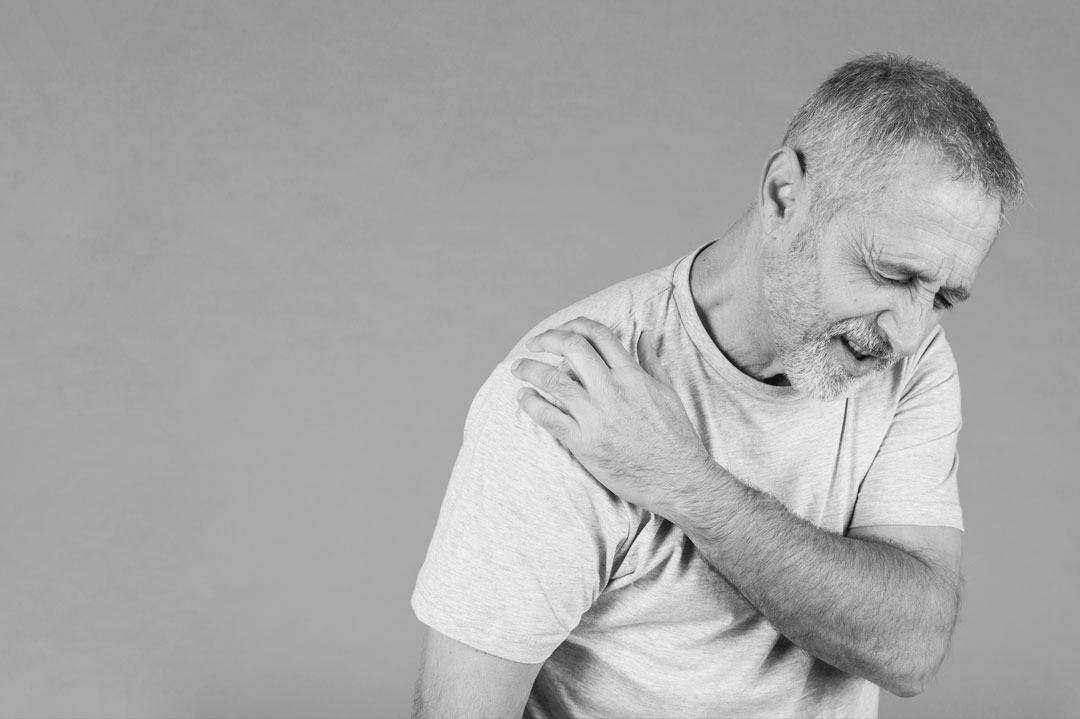
Two years dragging the same shoulder pain. An orthopaedic specialist, several physiotherapists, and surgery already on the table as a last resort.
Javier Morales Laguna had lived for almost two years with calcific tendinosis in the supraspinatus tendon of his left shoulder. He had been under orthopaedic follow-up and seen various physiotherapists without anyone solving the problem. By the time he arrived at Clínica Capón, surgery was already being planned as the next step, and he himself admits he arrived “quite discouraged after so long without improvement”.
This time, the process was different. In his own review he describes it in detail: “from the first session with Alvar Capón, and not forgetting Diego Dorrego’s contribution, I noticed something different. Not just because of the technical knowledge and precision in the diagnosis, but because of the closeness and human warmth from the very first moment.”
What calcific tendinosis is and why it differs from ordinary tendinitis
Calcific tendinosis of the supraspinatus is a calcium deposit in the tendon, within the shoulder’s rotator cuff. Unlike simple tendinitis — inflammation that usually responds well to conventional physiotherapy within weeks — the calcification changes the nature of the problem: the tendon tissue has degenerated to the point of building up calcium deposits, and that deposit can cause severe inflammation and pain that doesn’t yield to standard treatment.
It is exactly the type of case that, after going through several professionals without results, ends up drifting towards surgery almost by elimination — not because there’s no alternative, but because the real cause isn’t always properly identified.
A process of several months, with no shortcuts
Javier himself points to this as key: it wasn’t a quick fix. Recovery stretched over several months, with treatment adjusted session by session according to his progress. “He never gave up or settled for partial solutions,” he writes about Alvar Capón and Diego Dorrego’s follow-up.
The result: complete healing of the shoulder without going through surgery, after two years in which that outcome seemed increasingly unlikely.
Have you had shoulder pain that won’t improve?
When shoulder pain doesn’t respond after a long time and several professionals, the problem is usually an incomplete diagnosis, not that “there’s no solution”. At Clínica Capón we always start by precisely identifying which structure is damaged — simple tendinitis, calcification, a partial tear or subacromial impingement syndrome all require different approaches.